Tag: Upanishad
-
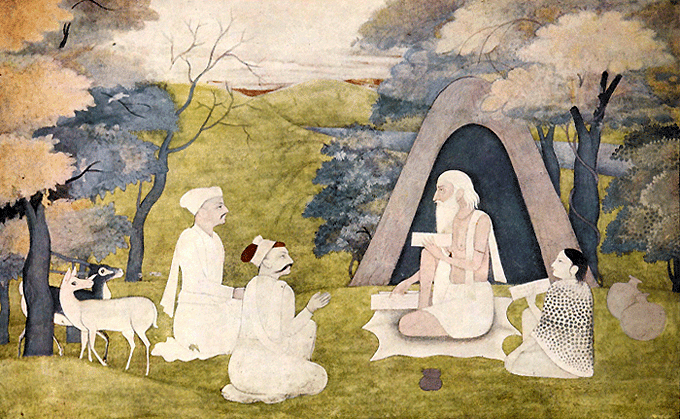
Family and society in the Vedic period
On the occasion of Guru Pūrṇimā, our thoughts may turn to the venerable lineages of successive teachers and students in India. As we will see, the need to record and preserve genealogical details of family and pedagogical lineages was already recognized in India in the earliest times. Indeed, this is very likely a continuation of…
-

Ethics in the Upanishads
Literature from across the world engages with ethical questions and moral quandaries, and plays a role in cultivating our moral sensibilities. Religious literatures often present ethical teachings indirectly, such as in the form of parables, or more directly, such as moral commandments. In the Upanishads of late Vedic India, we find both ethical and metaphysical…
-
The Iśāvāsya Upanishad
Trisul, Nanda Devi and Himalayan range from Kausani, Uttarakhand – Wikimedia Commons Pervaded by the dominion [of the Supreme] is all of this which moves in the moving world Having abandoned this, enjoy! Do not be acquisitive! For whose indeed is wealth? [Iśāvāsya Upanishad Verse 1; my own translation] This is the famous first verse…
-
The Wheel and the Dharmacakra
Dholavira Signboard — Wikimedia Commons From the Rig Veda to independent India Starting from maybe the mid-fourth millennium B.C., the proto-Indo-European people seem to have been constantly on the move, spreading out to the West and to the East. The full motivation for such rapid and multi-directional waves of migration is not well-understood, but the availability of…
-
Emotions and Indian Dramatic Expression
Todi Ragini, from a Ragamala Series — Cleveland Museum of Art Indian Aesthetics from the Upanishads to Bollywood “In the beginning, this [reality] was non-existent. Then existence was produced. That [Brahman] created itself by itself. So it is called well-made. That which is well-made is in fact rasa. For bliss arises only having obtained rasa.” [Taittirīya Upanishad 2.7.1]…
 Desire To Think